Pop-Up City Admissions
The question of admissions was - and still is - one of the most important questions to answer when creating an intentional community.
The original Zuzalu experiment attracted applicants mostly through invite-only and word-of-mouth channels. The application had a few simple questions, and weight seemed to be given mostly to the name listed in the "referral" field.
In the experiments I've helped to run, we've taken the approach of having a long application form that expects thoughtful responses by the applicant rather than relying on social proof (referral names, links) credentials alone.
How did I end up at Zuzalu? I was a regular of the Rationality Vienna meetup in Austria, and Vitalik joined our January 2023 meetup, where he let us know about the upcoming Zuzalu experiment and invited our group to attend. With his description, this simple flyer, and a simple application form, I was among a number who took a somewhat irrational leap of faith to join this social experiment (that has arguably changed the global landscape of online blockchain communities experimenting in offline coordination, attempting to scale beyond short and superficial gatherings in the direction of "crypto city building.")
When I was asked to organize a Zuzalu experiment in the country of Georgia alongside Burns, known as ZuVillage Georgia or ZuGeorgia, we spent a lot of time attempting to distill what we observed as the experimental components of the original Zuzalu experiment in order to clearly define which variables we would maintain or change for our iteration. The question of admissions was - and still is - one of the most important questions to answer when creating an intentional community. Zuzalu's decentralization came after internal debates on "citizenship" (among other topics) and this was not a question to be taken lightly. How can the door be wide open, make it accessible broadly and not rely simply on name-referrals as legitimacy indicators, while maintaining the high quality concentration of participants (at a low enough number for strong bonds, but high enough for subcultures ie somewhere around Dunbar's number)?
The "magic" of Zuzalu and its children experiments is closely tied with, if not nearly entirely based on, the people who participate. Other variables (such as permissionless scheduling and schelling point meal times) are effective because they enable serendipitous moments between the high quality people that are there to begin with; if one thing remains true a few years into a rapidly shifting landscape, it's that beyond anything else, we're playing a "people game" (and that's the best part).
We took the approach of a long application form. We didn't seek specific answers to our questions, but rather thoughtful answers. Did the applicant engage with at least one of the topics deeply? We took this as an indicator that they would engage with our discussion topics deeply in person during the experiment. We wanted to optimize for thoughtful effort, and it seemed to work; ZuVillage Georgia was full of deep discussions, productive disagreements, and an overall relatively serious academic environment (in comparison to other experiments that had less focus on the topical content side of things).
My favorite question was: Describe a belief you have updated within the last 1-2 years.
Demonstrating the ability to and awareness of updating one's beliefs is a very strong filtering mechanism for an intentional community based on "intellectual heterodoxy" as we signalled on our application form:
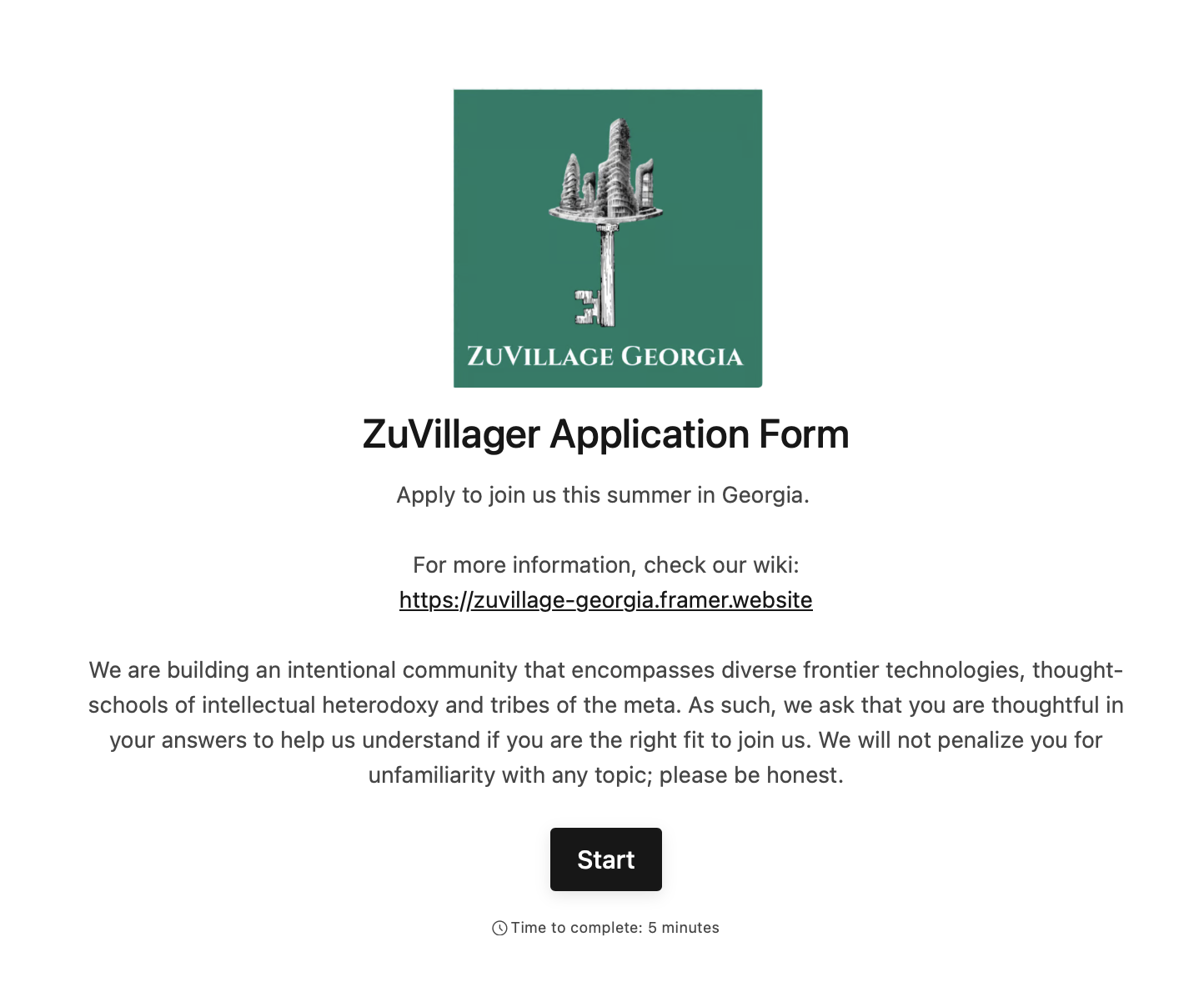
Quote: "We are building an intentional community that encompasses diverse frontier technologies, thought-schools of intellectual heterodoxy and tribes of the meta. As such, we ask that you are thoughtful in your answers to help us understand if you are the right fit to join us. We will not penalize you for unfamiliarity with any topic; please be honest."
The Zu-Grama project replicated the long application form model for their pop-up village this year. For Zuitzerland, we duplicated the ZuVillage Georgia application form directly, adapting some of the questions to fit the thematic breakdown of the programming.
It goes without saying that this mirrors how universities and educational institutions of all forms handle admissions; a combination of credentials, name-legitimacy, scores of a sort (Network School has actually even started implementing an aptitude test as part of their general application), alongside texts written by the applicant.
My alma mater famously has a "quirky" extended essay question such as "Where's Waldo" or "Find X" that helps optimize for the quirky intellectually curious student it prides itself as being a magnet for. I personally wrote an application essay about mantis shrimp and what they can see that we cannot (with this Oatmeal comic literally linked in the application question). I'm still somewhat baffled that it worked, but imposter's syndrome is a chronic condition.
P.S. My thoughts on ZuVillage Georgia were most fresh when I presented at the Network State Conference in 2024: https://www.youtube.com/live/OWEGg-ZTtSE?t=12081s I wish I had published my thoughts more often in the last years but better late than never!